
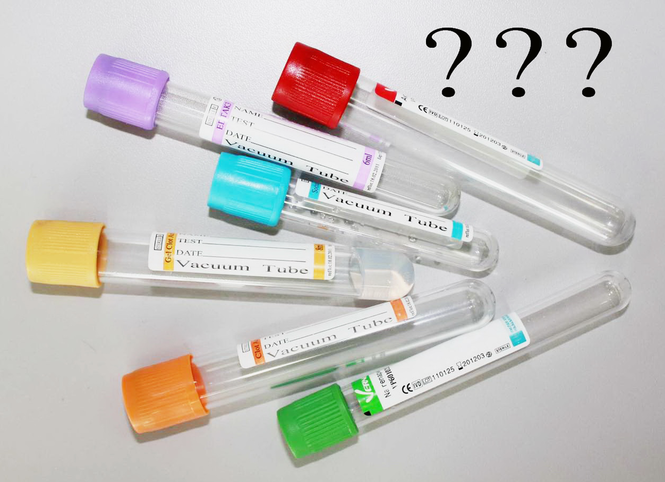
This article is our intellectual property and is available for reading upon payment of a fee equivalent to $10 (US dollars). We leave the responsibility for payment to your conscience, following the principles of European ethics, where, for example, a person honestly pays for the strawberries they have picked in someone else's field.
Payment details for Ukraine:
UA299358710000067321000114698 (FOP Verveiko V.I.)
For other countries: 4149500019820029 (Vitalii Verveiko)
PAYPAL: cross-fm2@mail.ru
I often encounter considerable uncertainty among fellow dentists when it comes to choosing tubes used to obtain fibrin clots and platelet-rich plasma. This is understandable: dentists have not studied physiology as extensively as physicians in other medical specialties. Hence the problem — an insufficient understanding of the subject. I will be glad if you, dear colleague, have studied hematology thoroughly, but statistics cannot be ignored: this article will be useful to many doctors who wish to start using the PRF technique in their practice.
I suggest starting by listing the objectives and then moving on to the methods of achieving them. If you have not yet read my previous article, "How to Properly Prepare PRF Clots", I highly recommend it!
So, the objectives.
1) Obtaining platelet-rich plasma that will clot before application
PRF clots. This is the coagulated portion of blood plasma containing numerous growth factors for osteogenesis and angiogenesis. Membranes and plugs can be prepared from it using a special PRF-BOX. The purpose of the PRF box is to compress the fibrin in order to remove excess plasma. The membranes are used to cover bone graft materials, palatal defects following the harvesting of gingival grafts, Schneiderian membrane perforations, and during sinus lifts. They are also used in periodontal surgery. Plugs are used to fill post-extraction tooth sockets and periodontal defects. Outside dentistry, clots are used for the regeneration of mucous membranes and skin.
The clots can also be cut into small pieces with scissors and mixed with bone substitutes.
Keywords:
PRF (platelet-rich fibrin);
A-PRF (advanced — advanced type);
CGF (concentrated growth factor);
SUPERFIBRIN (an ideal (best) method of preparing fibrin clots).
2) Obtaining platelet-rich plasma that will clot after application
This type of plasma is used for mixing with bone substitutes in order to stabilize them and give them a specific shape. It is also used for injections into periodontal tissues to improve their blood supply and change the gingival biotype. Sometimes it is used to glue the edges of mucous membranes together, for example, the Schneiderian membrane.
Keywords:
i-PRF (injectable);
AFG (autologous fibrin glue);
Sticky Bone.
3) Obtaining platelet-rich plasma that will NOT clot later
PRP plasma. It is used for PRP therapy, for example, for skin and joints. In cosmetology, the term "Plasmolifting" is currently fashionable. The PRP preparation technique assumes that the plasma will not coagulate either before or after being introduced into the patient's body. The mechanism of action is based on the same growth factors.
Keywords:
PRP (platelet-rich plasma);
Plasma therapy;
Plasmolifting.
Some general information about vacuum blood collection tubes
Everything begins with collecting blood from the patient's vein. Progress does not stand still, and the days when blood was drawn using a syringe and transferred into an ordinary tube are long gone. Meet the new standard! Ta-da! Vacuum blood collection tubes! They make the blood collection process fast, easy and convenient. Speed is the decisive factor in choosing vacuum tubes. Today, this is the only suitable standard for the PRF technique. Period! There are no other options. This is not an area where you should try to save money; otherwise, the result may be reduced tenfold. The same applies to catheters used to collect blood from the patient's vein and tube holders.
There are many manufacturers worldwide, and practically all of them follow generally accepted standards (international: ISO 6710:1995; interstate: GOST ISO 6710-2011). At present, there is no international agreement regarding color coding. When color coding is used, the codes in the following table are recommended:
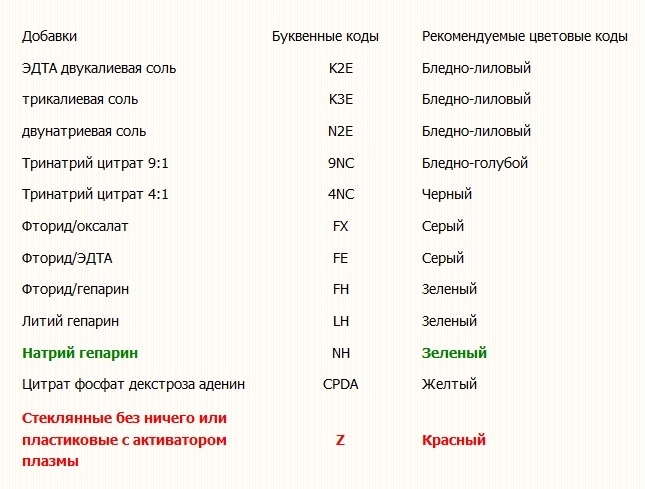
Please note: these are only recommendations. For example, the table does not include the marking for sodium citrate — blue. Therefore, it is necessary to examine the composition of the additive in greater detail, depending on the manufacturer, since color coding may differ.
Important! As a rule, the manufacturer does not affect the result. For example, the so-called "branded" or "original" Choukroun tubes are manufactured in China. "Plasmolifting" tubes are also manufactured in China. However, it is worth noting that identical types of tubes from different manufacturers may still differ in quality. For example, our English tubes have better plasma activator coating quality than the Italian ones.
Now let's look at the process of obtaining each type of plasma
1) Tubes for plasma that will clot before application (PRF, A-PRF, SUPERFIBRIN clots)
First, let's understand the mechanisms involved. Blood coagulation is a complex biological process involving the formation of fibrin protein strands in the blood. Fibrin polymerizes and forms clots, causing the blood to lose its fluidity and acquire a curd-like consistency. Silica, kaolin or the surface of glass can act as coagulation activators. The latter three activate Factor XII, after which thrombin is formed from prothrombin. Thrombin then activates the conversion of fibrinogen into fibrin. Fibrin subsequently does its job — it binds together and forms a clot.
Clotting time is 15–30 minutes (tube manufacturer's data; centrifugation is not assumed). Centrifugation and heating accelerate this process. Another important point: the clotting rate depends on the individual patient.
As a rule, tubes containing thrombin are not used to obtain PRF because five minutes may not always be sufficient for centrifugation. Let me remind you: the purpose of centrifugation is to allow erythrocytes to sediment before fibrin binding begins. When thrombin is used as an additive, there is a significant risk of clotting before the erythrocytes have separated, resulting in a red-colored clot.
This leaves the options of silica, kaolin or empty glass tubes. They usually have a red cap.
NB! Carefully invert the tube 5–8 times to ensure complete mixing with the reagents. Do not shake it: vigorous mixing may cause foaming and hemolysis!
Therefore, PRF and A-PRF require tubes containing a plasma activator (silica-coated tubes or empty glass tubes). If you still do not have a PRF box, take a look here: PRF-BOX.
You can purchase PRF tubes here: A-PRF tubes and here PRF tubes.
The SUPERFIBRIN technique requires completely different tubes. Take a look HERE.
2) Tubes for plasma that will clot after application (i-PRF, Sticky Bone, AFG)
The principle of obtaining i-PRF is as follows. Blood is collected from the vein into a container without a plasma activator. A portion of the liquid is separated from the red blood cells before fibrin binding begins. The resulting cloudy red liquid, which has not yet coagulated, is quickly drawn into a syringe and applied just as quickly. After several minutes, the liquid will thicken.
NB! Using thrombin or a coagulation activator is risky because the resulting i-PRF may thicken before it is used. Blood collection and the start of centrifugation must be extremely rapid!
Therefore, i-PRF requires tubes without an activator. You can purchase i-PRF tubes HERE.
The principle of obtaining AFG (Sticky Bone) is very similar, but it has its own specific features. Autologous fibrin glue for the so-called "Sticky Bone" is prepared in special Sticky Bone tubes. Red blood cells sediment as a result of centrifugation. The lower portion of the plasma (up to 1/2), at the interface with the erythrocytes, is collected using a syringe and used as intended.
NB! Please note! The material was obtained without using a coagulation activator, so some time is required for the thickening process. All stages can be performed without rushing. Centrifugation speed and duration can vary within a wide range; for AFG, this is not a critical issue.
3) Tubes for plasma that will not clot (PRP, Plasmolifting)
The PRP therapy technique has been used for more than 15 years. The objective when obtaining the centrifugate is to sediment erythrocytes while preventing coagulation. Centrifugation is usually performed at a relatively high speed for 8–12 minutes, which is sufficient for the red blood cells to sediment. If you have not yet purchased a centrifuge, consider this option: Centrifuge for PRF and plasma therapy.
As for additives, an anticoagulant must be used to prevent the centrifugate from clotting. Sodium citrate or sodium heparin can be used as additives. Each has its own specific features. Sodium citrate binds calcium in the blood and thereby inhibits coagulation. However, if calcium chloride is subsequently added to the centrifugate, it will still clot.
Heparin participates in the formation of the thrombin–antithrombin III complex. As a result, thrombin becomes bound and is no longer capable of converting fibrinogen into fibrin, preventing blood coagulation. After heparin has been used, clotting the blood is practically impossible unless a large amount of thrombin is added. Neither of these anticoagulants prevents platelet aggregation.
It is worth noting that patients frequently develop hematomas after injections of PRP obtained using a heparin additive. I hope the reasons are clear.
Therefore, PRP therapy and Plasmolifting require vacuum tubes containing sodium citrate or sodium heparin (not lithium heparin). You can purchase them HERE.
If you have not yet watched the webinar about PRF, be sure to watch it here: http://cross-dental.com/posts/1668894.
I would like to remind you that this article is our intellectual property and is available for reading upon payment of a fee equivalent to $10 (US dollars).
Payment details for Ukraine:
UA299358710000067321000114698 (FOP Verveiko V.I.)
For other countries:
4149500019820029 (Vitalii Verveiko)
PAYPAL: cross-fm2@mail.ru
If this material has been useful to you and you appreciate the author's work, you can contribute to the further development of science in the field of PRF and PRP by paying a larger amount, since plasma analysis using a hematology analyzer is an expensive procedure.
If you would like to gain further knowledge on this subject, I invite you to visit our Facebook page: CROSS-DENTAL.
Full or partial copying of this article is prohibited!
Best regards, author Vitaliy Verveiko (Crossovok).


